Why children love hearing their own name in a story
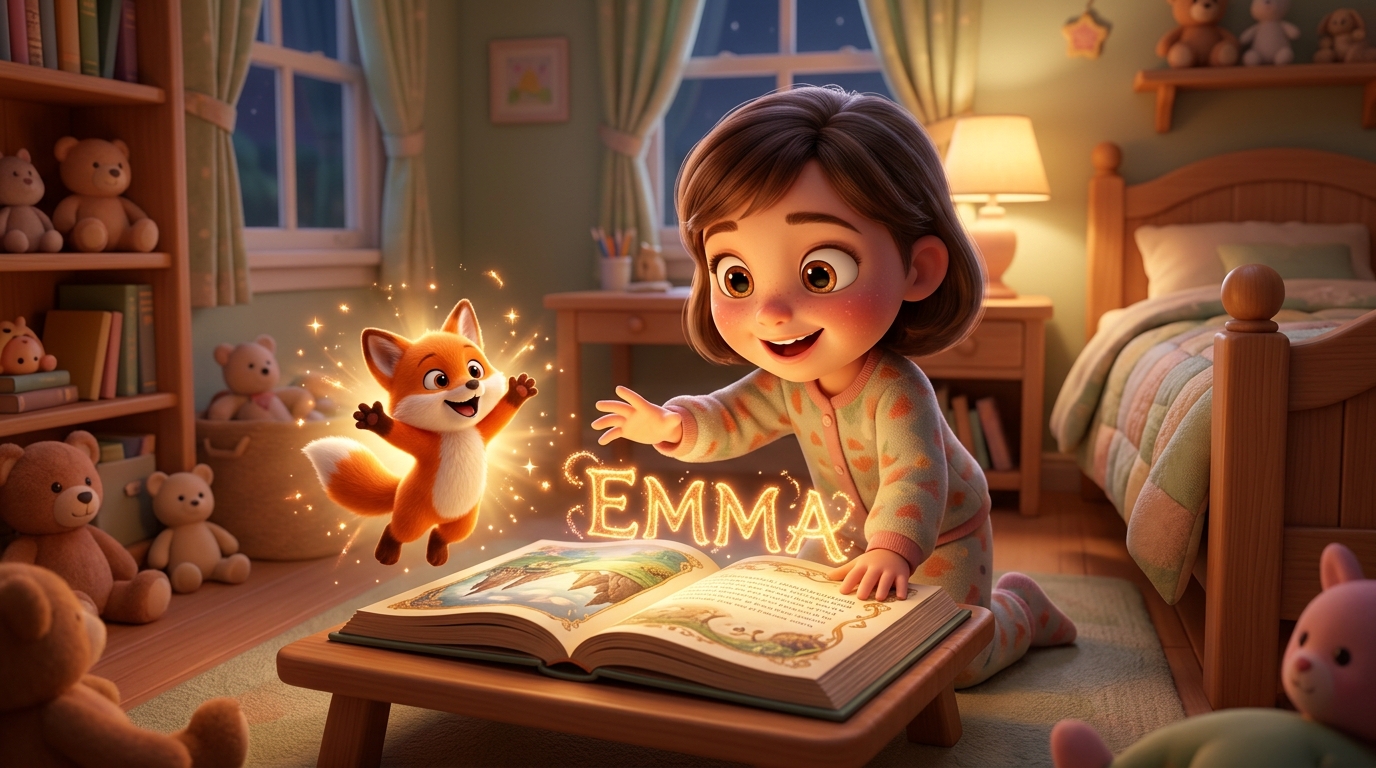
It happens every time. You're reading a story and the child's name appears — and suddenly their eyes grow wider, their body sits up straighter, and their attention is fully present. "That's me!" they say. And the smile is unmistakable. Why do children react so strongly to this? And what does it actually do for them?
Children love hearing their own name because the brain prioritizes personal information via the Cocktail Party Effect. It shifts the child's role from passive observer to active hero, which increases engagement, strengthens their self-image, and creates a deeper emotional connection to the story's plot and characters.
What is the Cocktail Party Effect and how does it affect children?
Psychologists call it "The Cocktail Party Effect" — our brain's ability to pick up our own name even in a room full of noise and other conversations.
The phenomenon was first described by the British psychologist E. Colin Cherry in 1953 and has since become one of the most studied topics in cognitive psychology.
Research shows that the brain processes our own name fundamentally differently than other words. It activates areas in the brain associated with self-awareness and identity. Moray (1959) demonstrated that subjects could pick up their own name in an unattended audio channel — a finding that has shaped our entire understanding of selective attention.
When a child hears their name in a story, something neurologically special happens: the brain shifts from passive reception to active participation. Read also our review of how bedtime stories strengthen language development.
Why do children become more active when they are the hero of the story themselves?
There is a crucial psychological difference between hearing a story about "a girl named Sophie" and hearing a story about you.
Identification
When the child is the hero of the story, they identify completely with the character. The child's curiosity, courage, and problem-solving — these are their own. Read more about how personalized stories boost vocabulary.
Active listening
Research documents that children's engagement during read-alouds increases significantly when they make connections to the characters. Children who hear their own name listen more actively and intently — they are not spectators to someone else's adventure, they are participants in their own.
Emotional resonance
Stories about ourselves touch us more deeply than stories about strangers. This applies to adults — and even more so for children who are still in the process of understanding who they are.
How do personalized stories strengthen a child's self-understanding?
When a child is the hero of a story — a child who is brave, smart, and solves problems — it sends a message to the child's subconscious: this is how you are. This is who you can be.
Research in narrative psychology shows that the stories we tell about ourselves shape our self-understanding. A child who regularly hears stories about themselves as a brave, curious, and good problem solver gradually begins to internalize that identity.
What is the significance of including the family in the child's story?
The magic moment becomes even stronger when the child is not alone in the story — but surrounded by those they care about most.
Grandma's name. The dog's name. A best friend's name. The little brother who always teases but is always there.
These names in a story are not just words. They are anchors to reality — proof that this story was created for exactly this child and no one else. Read also about how Flipr's 3D avatars create visual identification, how to create your family's avatars and how friends can create stories together.
How do children react when they recognize themselves in a Flipr book?
Parents using Flipr describe the same moment again and again:
It's not the plot of the story that gets the children. It's the second they hear the dog's name. Or the grandparent's name. Or their best friend's name appearing in an adventure they themselves have described.
"That's when their eyes light up," as one mother describes it. "And then they laugh — because it's them. It's really them."
How can you use your child's name in everyday bedtime stories yourself?
You don't need an app to give your child the experience of hearing their own name in a story. Next time you improvise a bedtime story — use the child's real name, include family characters, and let them be the hero.
Read our article on why children love to read about themselves to understand the deep science behind the effect of personalization.
But if you want to give them that experience every night — with illustrations, with their own avatars, and with a world they have chosen themselves — Flipr is built for exactly that.
Try Flipr for free — let your child hear their own story
From what age do children understand that they are the hero of the story?
As early as 5 months of age, infants react to their own name. The full understanding that "this is about me" develops gradually and is typically fully established from ages 4-5.
Is it better for the child to be the hero themselves or to identify with a character?
Research suggests that direct personalization — where the child is literally the hero — has a stronger effect than identification with a fictional character. However, both forms of engagement are valuable.
Can it make children too egocentric to always be the hero?
No — on the contrary. Feeling seen and valued in a story strengthens a child's empathy and ability to put themselves in others' shoes. A child with a strong self-image finds it easier to show consideration for others.
Let your child hear their own story
Reference: Cherry, E. C. (1953). Some experiments on the recognition of speech, with one and with two ears. Journal of the Acoustical Society of America. | Moray, N. (1959). Attention in dichotic listening: Affective cues and the influence of instructions. Quarterly Journal of Experimental Psychology. | Newman, R. S. (2005). The cocktail party effect in infants revisited: Listening to one's name in noise. Developmental Psychology.
Read also
- Behind the 3D Avatar: Why Visual Identification Boosts Your Child's Engagement
- Why children love reading about themselves — the science behind it
- From 0 to 100 Words: How Personalized Stories Boost Your Child's Vocabulary
- How to Create Your Family’s Avatars in Flipr
- Social Co-creation: Strengthening Friendships and Empathy Through Shared Storytelling
- Learn a new language with Flipr: 10 minutes a day can make a world of difference