Easy Reader Books vs. Personalized Stories: What Works Best for Beginning Readers?
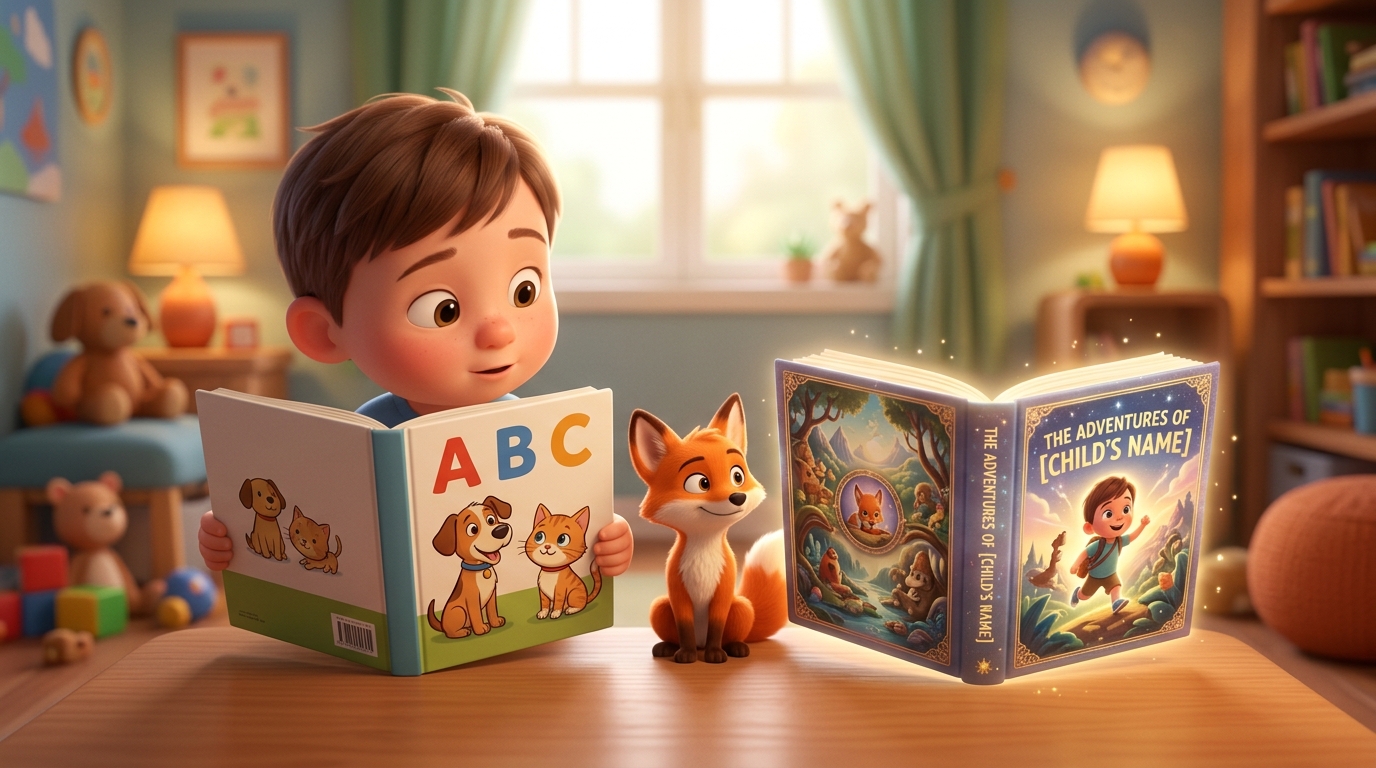
For decades, easy reader books have been the standard choice for children in grades K-3. They are categorized by level, affordable, and easy to find. However, a new type of storytelling – personalized and adaptive – is challenging that image. Here is the honest comparison.
Personalized stories work best for increasing reading motivation since the child is the hero, while easy reader books are ideal for ensuring a consistent academic level. The optimal solution for beginning readers is to combine both, so the child gets both the physical book experience and the strong identification from personalized narratives.
What are easy reader books and how do readability levels work?
Easy reader books (also known as 'leveled books') are books written with controlled vocabulary and short sentence structures, divided into levels:
- Level 5-10: The very first words (Grade K-1).
- Level 10-20: Short stories with familiar words (Grade 1-2).
- Level 20-30: Short chapter books (Grade 2-3).
- Level 30+: Regular chapter books (Grade 3+).
Classic examples in Denmark: Frøken Ignora, Gummi-Tarzan (easy reader version), the Dingo series, Pixi books with chapters.
What are the benefits of classic easy reader books?
- Level security: The teacher or parent knows exactly what the difficulty level is.
- Affordable and accessible: Libraries and schools have them by the hundreds.
- Short – easy to finish: An important victory for beginning readers.
- Visually clear: Large font, short line lengths, plenty of pictures.
Why can traditional beginner books lose a child's interest?
- Themes rarely hit the mark: A book about Frøken Ignora is for everyone. It’s not about your child’s favorite football team or most beloved dinosaur.
- Lack of identification: The protagonist is an abstract character, not the child themselves.
- Static selection: Once the child has read the 30 books at their level, there are no more – or the jump to the next level is too large.
- Adult-curated: Children often express that the books are 'boring' or 'too babyish'.
What are personalized stories and how do they work?
Personalized stories are narratives generated with the child as the protagonist, including their name, their friends, and their favorite themes. The level is dynamically adjusted to the child's age and reading ability.
The Strengths
- Maximum motivation: Being the hero of your own story is the strongest motivational tool available.
- Endless selection: Never the same story twice.
- Dynamic leveling: The language automatically changes with the child.
- Theme chosen by the child: The most important difference.
The Limitations
- Requires an app or screen: For some families, this is a barrier.
- Parents cannot see the level in the same way: Harder to assess from the outside.
- Lacks the physical book experience: The smell, the pages, the act of physically putting a book down.
How do easy reader books differ from personalized stories?
What does research show about motivation and the joy of reading?
There are not yet direct studies comparing specific AI personalized stories with easy reader books. However, related research is clear:
- Identification with the protagonist significantly increases reading motivation and retention (Mar, Oatley & Peterson, 2009).
- Self-selected reading results in 3-5x more reading time than assigned reading (Krashen, 2004).
- Dynamic level adjustment reduces drop-off among struggling readers (US Department of Education, 2017).
All three factors are core strengths of personalized stories.
Why should you combine books with apps like Flipr?
Easy reader books are still important – especially in school and at the library, and as physical books a child can carry in their bag. Personalized stories are the strongest supplement when motivation is lacking, or when the child is tired of school and 'doesn't feel like reading'.
Many parents report that their child first finds the joy of reading through personalized stories, and then starts reaching for physical easy reader books again. This is the ideal sequence.
Flipr is built for exactly this – personalized stories where your child is the hero, adapted to age and reading level, so you can supplement easy reading in a way that sparks interest.
Read also our complete guide to independent reading and our review of the best apps for personalized children's stories.
And our honest reflection on can AI stories replace real books.
What works best for beginning readers in the end?
Easy reader books are excellent tools – but they are not enough on their own if the child has lost interest. Personalized stories fill exactly that gap in desire, and when combined, they provide the broadest path to becoming a strong reader.
Do personalized stories replace easy reader books entirely?
No – the best results come from using both. Easy reader books provide the physical book experience and are great in a school context. Personalized stories provide motivation and dynamic level adjustment, which is difficult to find in a static series.
Why do personalized stories work so powerfully for beginning readers?
Because the child is the hero. Identification with the protagonist is one of the strongest motivational factors that exists, and when the story is about the child's name and favorite theme, the resistance to reading drops significantly.
Does a personalized story on an app count as 'real' reading?
Yes. Research shows no significant difference in reading outcomes between paper and dedicated reading apps – as long as the device doesn't show games or notifications at the same time. It is reading that builds vocabulary and speed, regardless of the medium.
My child reads fluently – do they still need easy readers?
If the child is already reading fluently on their own, easy reader books are not necessary. The focus should be on independent reading at an appropriate level – chapter books, series, non-fiction books – and personalized stories can supplement when motivation dips.
Supplement easy reading with personalized stories
Reference: Mar, R. A., Oatley, K., & Peterson, J. B. (2009). Exploring the link between reading fiction and empathy. Communications, 34(4), 407-428.
Read also
- My child won't read: 7 things that actually work
- Bookworms: How to raise a child who loves to read
- Can AI Stories Replace Real Books?
- Pleasure Reading: The Complete Guide to Turning Your Child into a Reader
- Why children love reading about themselves — the science behind it
- How Much Does Flipr Cost? A Complete Guide to Gold Coins and Plans