Is it okay to use an iPad for bedtime stories?
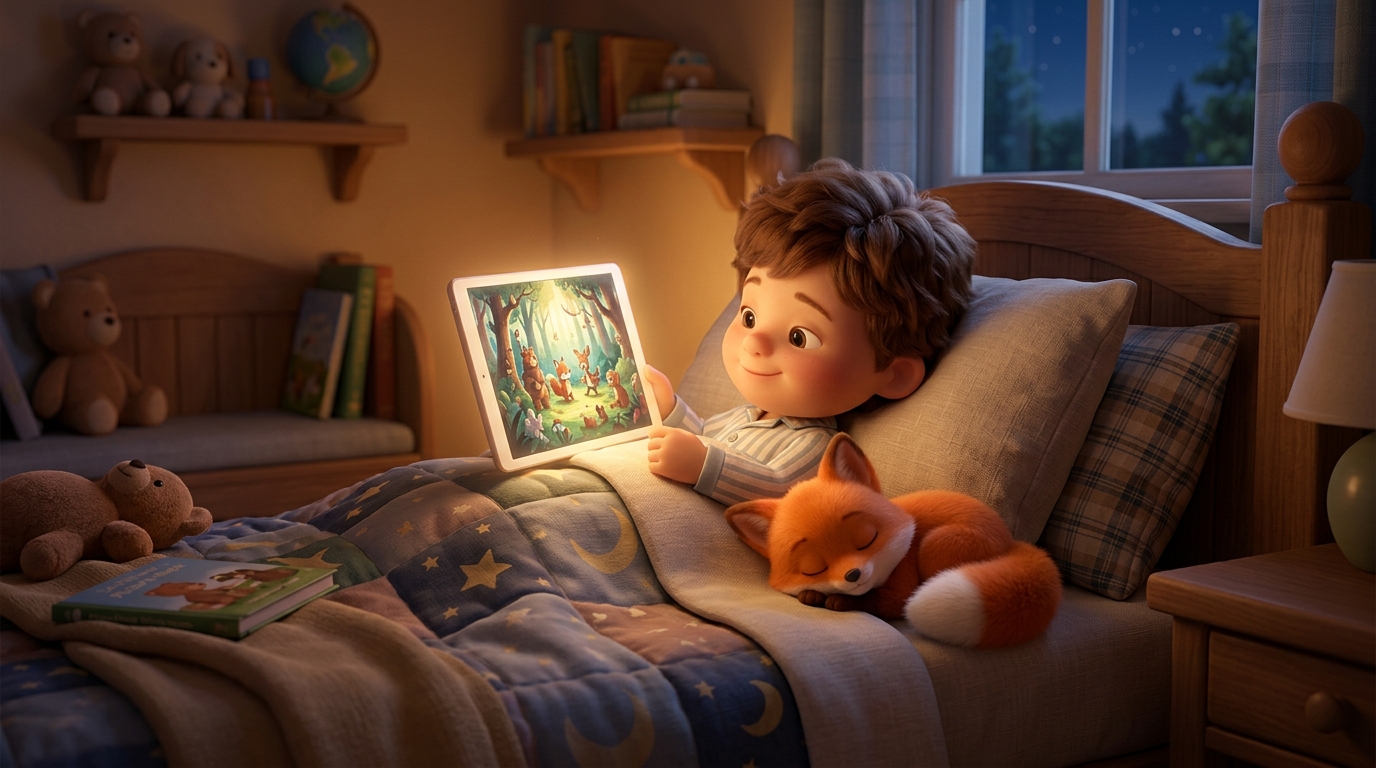
You know you probably shouldn't. Experts say screens and bedtime don't mix. And yet, there you are at 8 PM with an iPad and a child expecting a new story. Are you a bad parent? No. Is it always harmful? It's more nuanced than that. Here, we review what the research actually says about evening screen time — and when an iPad for bedtime stories can be a sensible solution.
Yes, it is okay to use an iPad for bedtime stories if the content is calm and part of a fixed routine. Research distinguishes between passive screen time and active interaction. By using night mode and choosing stories over games, the iPad can create a secure and present end to the day.
How does screen time and blue light affect children's sleep?
Research shows that blue light from screens can affect the production of melatonin — the hormone that helps the body fall asleep. This is the primary concern regarding screen time close to bedtime.
But research doesn't always distinguish between passive screen time (watching YouTube or playing games) and active, meaningful screen time (listening to a story or reading).
There is an important difference. Read more about the difference between passive and active screen time here.
What is the difference between passive and active screen time?
The World Health Organization (WHO) and the American Academy of Pediatrics primarily warn against uncontrolled, passive screen time — not against all forms of digital activity.
An iPad used to listen to a bedtime story is fundamentally different from an iPad used to play Roblox or watch YouTube. One stimulates and excites, while the other can be a calm and cozy end to the day — just like a physical book.
The keyword is context.
When is an iPad with stories an advantage for bedtime?
When it replaces stress with coziness
If the alternative is a tired parent improvising a boring story or retelling the same book for the 14th time — a well-chosen app can actually make the evening better for everyone.
When the content is age-appropriate and calm
A personalized bedtime story featuring your child’s own name and family is not the same as action games or social media. It is more like a digital version of reading aloud.
When it is part of a fixed routine
Routines are important for children's sleep. If the iPad becomes a fixed and bounded part of the bedtime routine — 15 minutes with a story, then the screen is turned off — it can actually help children relax. Read our guide to a calm bedtime routine.
When parents are present
Listening to a story together with your child is a shared experience — not a substitute for presence.
When should you avoid using screens at bedtime?
Close to sleep time without a transition
Try to have a 15-20 minute "buffer" between turning off the screen and the child going to sleep. If your child generally has difficulty falling asleep, you can find concrete tips in our guide.
If the child becomes excited rather than calm
Not all children react the same way. If your child becomes more alert from screen time in the evening, it is a signal to adjust the routine.
If it is uncontrolled
A defined story time is different from unlimited access to an iPad at bedtime.
How do I reduce blue light on the iPad before bedtime?
If you use an iPad for bedtime stories, you can reduce the impact of blue light:
- Turn on Night Shift on the iPad (Settings → Display & Brightness → Night Shift)
- Reduce the screen brightness
- Use Flipr's built-in night mode which automatically dims the screen and slows down the narrator's pace
How do I create a balance between technology and presence?
The most engaged parents we talk to do not use Flipr as a substitute for presence. They use it as a tool that gives them the freedom to focus on the cozy moment itself — sitting close with their child and experiencing a story created especially for them.
It’s not screen time at the expense of quality time. It is quality time with technology as a tool. Also read our guide on how personalized stories can help with fear of the dark.
Is an iPad for bedtime stories a good solution for my child?
Is it okay to use an iPad for bedtime stories? Yes — if it is bounded, the content is calm, and it is part of a fixed routine.
Is it ideal for all children in all situations? No — you know your child best.
The most important thing isn't which technology you use. It is the coziness and presence you create in those minutes while your child falls asleep.
Read also our guide on how Flipr protects your children's data.
How much screen time is too much for children?
WHO recommends no screen time for children under 1 year, a maximum of 1 hour per day for 3-4-year-olds, and a focus on quality over quantity for older children. Talk to your doctor if you are unsure about your child's specific needs.
When should the screen be turned off before bedtime?
Most experts recommend a 30-60 minute buffer without screens before sleep. However, a calm, bounded story time close to bedtime is different from active screen time.
Is it okay to use an iPad for bedtime stories?
Yes — if it is bounded, the content is calm, and it is part of a fixed routine together with the parents. It is fundamentally different from passive screen time like YouTube or games.
Does Flipr have a night mode?
Yes — Flipr's night mode automatically dims the screen and slows down the narrator's pace to create a calmer experience at bedtime.
What is the difference between passive and active screen time?
Passive screen time is receiving content without interaction — like watching videos. Active screen time involves engagement, choices, and reflection. Listening to a personalized story where the child is the hero is active, meaningful screen time. [Read our guide to active screen time](/blog/skaermtid-med-god-samvittighed).
Make the bedtime routine easier with Flipr — try for free
Read also
- What is the Best Age for Bedtime Stories?
- Do Bedtime Stories Boost Children's Language Development?
- Screen time with a clear conscience: How to transform passive consumption into active learning
- How to write a great bedtime story prompt — for AI and for yourself
- Is my children's data safe in Flipr?
- The ultimate guide to a calm bedtime routine: Why personalized stories are the shortcut to dreamland