How to write a great bedtime story prompt — for AI and for yourself
Published · Written by the Flipr editorial team
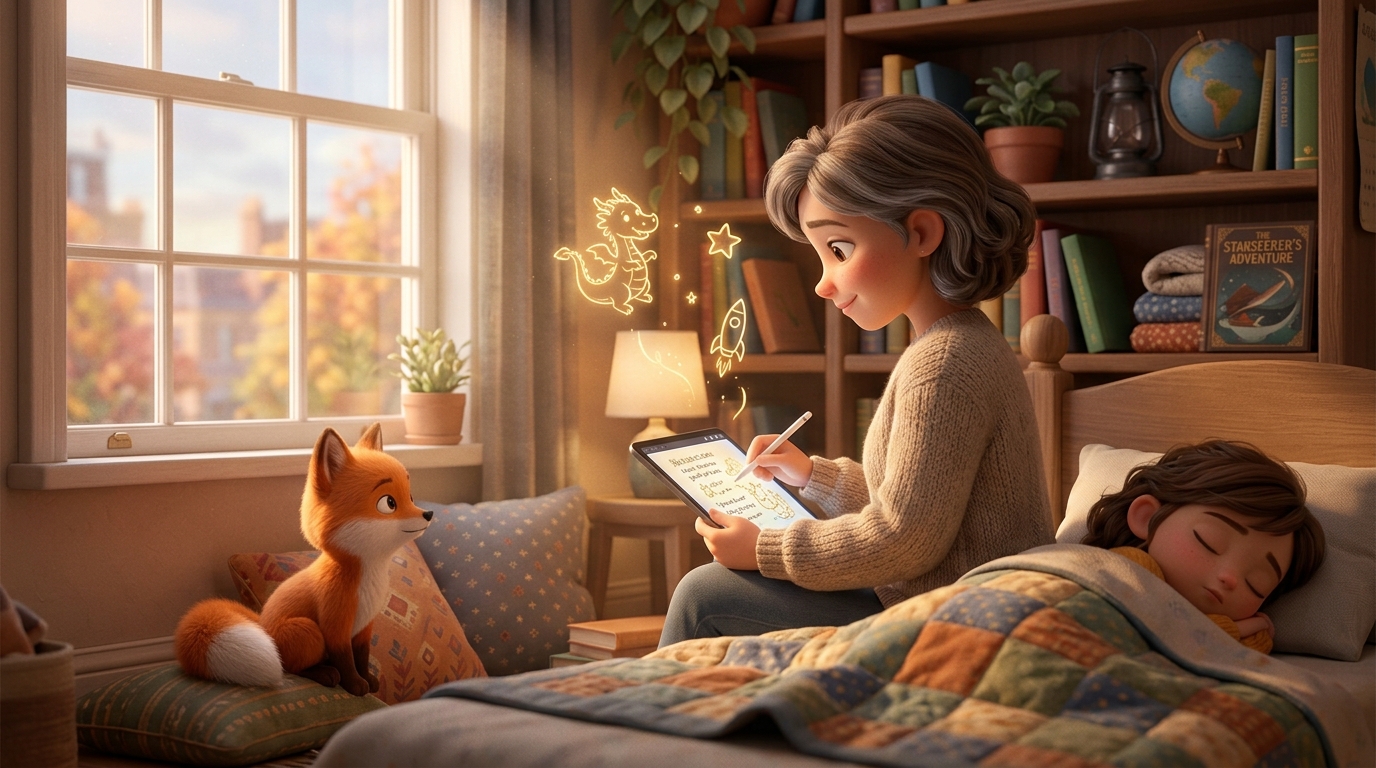
7:45 PM. Your child looks up at you expectantly. You open the app — or take a deep breath before you start improvising. And then it happens: you say the first words, and the story either captures them instantly or slowly dies out while your child starts staring at the ceiling. What's the difference? The answer is almost always the same: details.
A great bedtime story prompt is built around four elements: a specific protagonist, a clear desire, both an external and internal obstacle, and a surprising detail. By combining these ingredients, you create a captivating tale, whether you're improvising yourself or using an AI app like Flipr to make your child the hero.
Why do bedtime stories often become boring and generic?
Most bedtime stories start too vaguely. "A girl on an adventure." "A knight fighting a dragon." "A rabbit that finds something."
These aren't bad ideas. They just aren't stories yet. They are categories.
An AI given a vague prompt guesses at everything — who the character is, what they want, what is difficult for them. The result becomes generic because there is nothing personal to build on.
The same thing happens when you improvise. Without a concrete starting point, the brain improvises the first generic images it finds — and that is rarely what captures a child's attention.
How do you write the best prompt for a bedtime story?
The best bedtime stories — whether generated by AI or told spontaneously — follow this simple formula:
> Who + what do they want + what stops them + one surprising detail
Let's go through each element:
Who
Be specific about the character. Not just "a girl" — but "Emma, 7 years old, who loves dinosaurs and is a little afraid of the dark."
The more concrete the character is, the easier it is for both the AI and your own brain to create something vivid. A name, an age, a personality trait.
Weak: "A girl"
Strong: "Emma, 7 years old, who always has a plan — but whose plans almost never go as expected"
What do they want
All good stories are about something. The hero wants something — and that drives the narrative forward.
The desire doesn't have to be dramatic. It could be finding a friend, proving something to themselves, solving a mystery, or getting home. The important thing is that it's clear.
Weak: "Wants an adventure"
Strong: "Wants to prove she is brave enough to climb to the top of the tall tower in the forest before sunset"
What stops them
Without an obstacle, there is no story. It is the obstacle that creates tension and drives the child to keep listening.
The strongest obstacles work on two levels:
The external problem: A concrete challenge — the tower is taller than expected, the weather changes, someone tries to stop her.
The internal problem: The hero's inner doubt — am I brave enough? Can I trust myself? Am I good enough?
The internal problem is what gives the story emotional depth and makes it memorable. Children recognize inner doubts — even when they have never climbed a tower.
Weak: "But it's hard"
Strong: "But her legs are shaking and the inner voice says she can't. Foxy the fox believes in her — but Emma must take the final step herself"
One surprising detail
This is the detail that makes the story unique and impossible to forget. It's the element that isn't predictable — the thing that makes the child ask "why?" and want to hear more.
The surprising detail can be:
- An unexpected character trait ("a T-rex that is afraid of the dark")
- An absurd situation ("a robot that can only speak backwards")
- An unexpected contrast ("the mightiest wizard in the world who can't find his glasses")
- A recognizable everyday detail in a fantastic world ("the astronaut who forgot his lunch box")
Weak: "A dinosaur on an adventure"
Strong: "A green T-rex named Kevin who is afraid of the dark"
What does a good prompt formula look like in practice?
Example 1 — From vague to vivid
Before:
> "A story about a knight"
After:
> "Sir [child's name] is the youngest knight in the kingdom — and the only one who can't swing a sword properly. When Eld the dragon attacks the village, all the other knights are sick. Sir [child's name] is the only one left. But instead of a sword, [child's name] has something much more unexpected: a recipe for the world's best cake — and a theory that dragons are actually just lonely."
Example 2 — Everyday life as an adventure
Before:
> "A funny story"
After:
> "It's raining outside and [child's name] is indoors. Out of boredom, [child's name] starts building a castle out of blankets and pillows in the living room. But when the last blanket is placed, something strange happens — the castle is no longer a toy castle. And the little voice from the corner of the room belongs to someone who has lived here much longer than [child's name]."
Example 3 — The difficult day
Before:
> "An encouraging story"
After:
> "[Child's name] made a mistake today and feels bad about it. Foxy the fox appears and tells stories about the ten greatest inventors, heroes, and adventurers in history — and what they all have in common: they all made exactly the same kind of mistake that [child's name] did today. And it was that mistake that taught them the most important thing they ever knew."
Which techniques can make a bedtime story even better?
1. Sensory details
Good stories aren't just told — they are experienced. Add one sensory detail to every scene: what does it smell like, what does the hero hear, what does it feel like in their stomach.
"The forest smelled of wet leaves and something sweet [child's name] couldn't put a name to" is much stronger than "They walked into the forest".
2. Use the child's real world
The more the story draws on elements from the child's real life — friends, pets, places they know, things that happened that day — the more personal and alive it becomes.
A dog that appears in a fantastic world with its real name is more magical than ten invented characters.
3. Let the hero make the decisive choice
The most important moment in a good bedtime story is the moment where the hero chooses to act — despite fear, doubt, or adversity.
Make sure it is the hero's choice — not a coincidence or someone else's help — that resolves the story. It sends a powerful message to the child: you can solve problems. You are brave enough.
How do I get started with personalized stories at Flipr?
The formula works whether you use AI or tell the story yourself. Try it tonight:
- Choose a character with a concrete name and one personality trait
- Give them a clear desire
- Add an obstacle that works both externally and internally
- Find the one surprising detail that makes it unique
And if you want AI to build the story with your child as the hero — with your own characters, illustrations, and narration — Flipr is built for exactly that.
How long should a good prompt be?
A good prompt is typically 3-5 sentences. Long enough to establish the character, desire, and obstacle — short enough for the AI to still have the freedom to create something surprising.
Can I use the formula to improvise without AI?
Absolutely — the formula is a universal storytelling tool that works regardless of the medium. Many parents use it as a mental checklist before they start telling a story.
What if the child wants to hear the same prompt again?
That's a good sign — the prompt is hitting the right note. In Flipr, a new, unique story is generated every time, even with the same prompt. You get variation without having to invent something new.
Do I always have to follow the formula?
The formula is a tool — not a rule. Once you've used it a few times, it becomes intuitive and you won't need to think about it consciously. The important thing is to have something concrete to start with.