Using Stories to Talk About Feelings: A Guide for Parents
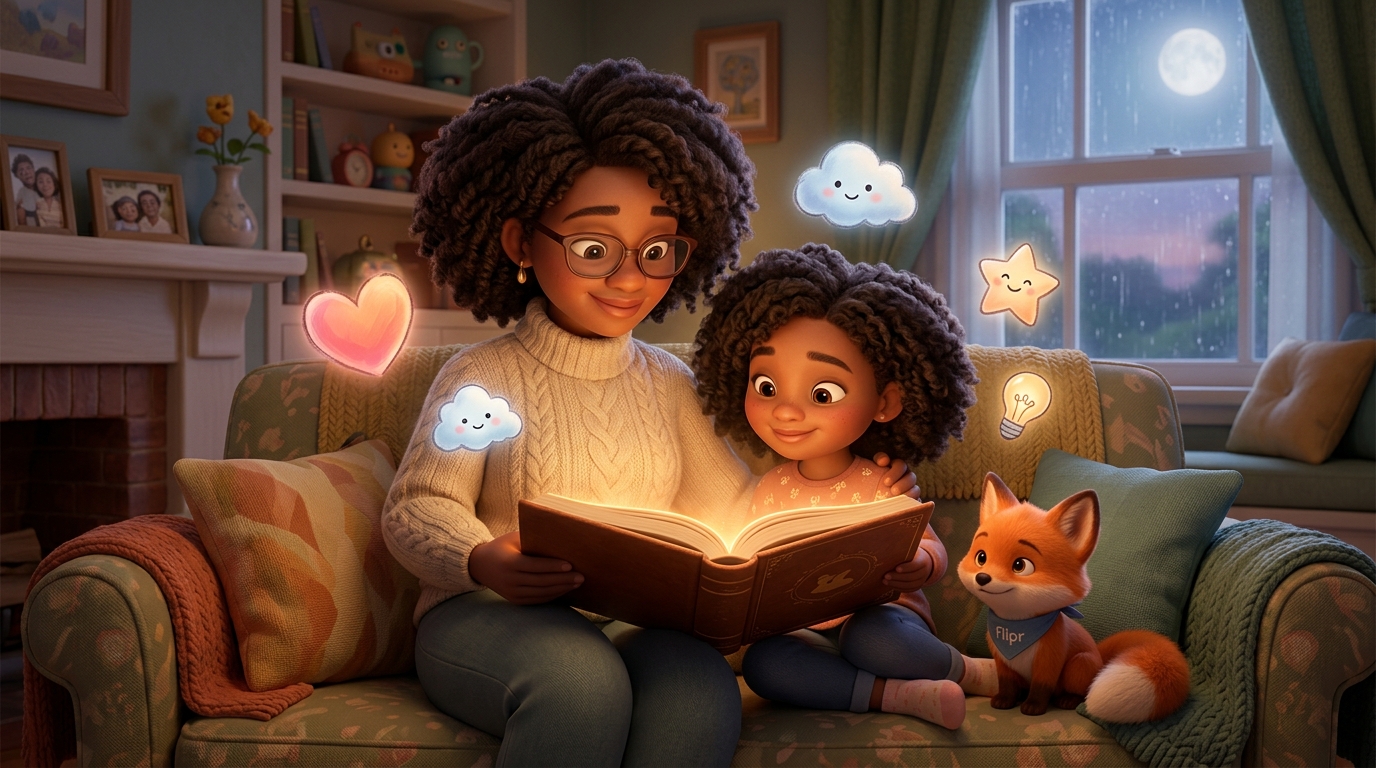
A child's emotional life is complex and can often seem overwhelming for both children and adults. Anger, jealousy, grief, nervousness ‒ these emotions are a natural part of being human, but it can be difficult for children to understand and express them. As parents, we often search for ways to open up these conversations, and here, stories prove to be an invaluable tool.
Stories help children understand emotions by creating identification and a safe distance from difficult topics. Through the characters' experiences, children gain a language for their own feelings and concrete models for solutions. By using tools like Flipr, the child can become the hero themselves, making the conversation about feelings more immediate and easier to handle.
Why are stories good for teaching children about feelings?
Stories have a unique ability to bridge the gap between a child's inner world and those large, often overwhelming, emotions. When children read or listen to stories, several things happen:
- Identification: Children can identify with characters experiencing similar feelings. This normalizes their own experiences and shows them they are not alone.
- Safe distance: Stories provide a safe distance from emotions. It is easier to talk about a character's anger than one's own, which can open the door for dialogue.
- Language for feelings: Stories introduce words and concepts that help children put a name to their emotions and express them more precisely.
- Solution models: Characters in stories often find ways to handle their emotions, which can give children concrete strategies and hope.
- Empathy: By following a character's emotional journey, children develop their empathy and understanding of others' perspectives.
How can stories help children with anger, grief, and jealousy?
How does Flipr work as a tool for a child's emotional development?
While traditional books are fantastic, Flipr takes the concept a step further by offering personalized stories. When the child is the main character in the story, the identification and emotional resonance are significantly enhanced. With Flipr, parents can tailor stories to specific situations. Is your child nervous about starting school? You can create a story where the child's avatar, along with their favorite pet, navigates a similar situation and finds their courage. This form of "social stories" is a recognized pedagogical tool for preparing children for new or challenging situations.
Flipr's "Story of the Day" feature also makes it possible to integrate these conversations into daily life. By choosing themes that relate to the child's current challenges, parents can use the stories as a springboard for important bedtime conversations – for example, to ease major transitions like starting school or moving or to create security against fear of the dark. A concrete example is The Silent Center of the Storm, which helps the child find calm in the midst of chaos.
How do you start a good conversation about feelings after reading?
Once you have read a story that touches on difficult feelings, you can use these questions to open up a dialogue:
- "How do you think [character's name] felt when that happened?"
- "Have you ever felt the same way?"
- "What do you think about the way [character's name] solved the problem?"
- "What would you have done if you were in [character's name]'s place?"
Remember, the goal is not to "fix" the child's feelings, but to listen, acknowledge, and validate them. Stories are simply the key that unlocks the door to these important conversations.
How do I choose the right story for my child's feelings?
Choose stories that reflect the specific emotion or situation your child is facing, but with a character they can relate to. With Flipr, you can even tailor the story so the child is the main character, making it even more relevant.
What if my child doesn't want to talk about the story afterward?
That is perfectly okay. Sometimes children need time to process the story internally. Do not press for a conversation. You can always return to the story later or simply let it work quietly.
Can stories help with serious trauma?
Stories can be part of a healing process, but for serious trauma, one should always seek professional help. However, stories can be a good supplement to therapy.
Is it best to read the stories aloud or let the child read them alone?
Both can work. Reading aloud allows for immediate interaction and support, while independent reading can give the child peace to reflect at their own pace. Flipr's 'Dual Reading Modes' support both approaches.
How can Flipr help with specific challenges like fear of the dentist?
You can use Flipr to create a story where the child's avatar visits the dentist and experiences that it isn't scary at all. This works as a 'social story' that prepares the child and demystifies the situation.
Help your child understand their feelings through stories
Reference: Bettelheim, B. (1976). The Uses of Enchantment: The Meaning and Importance of Fairy Tales. Knopf. | Gray, C. (1998). Social stories and comic strip conversations with students with Asperger syndrome and high-functioning autism.
Read also
- When Daily Life Changes: Use Stories to Ease Transitions for Your Child
- How to prepare your child for something new with their own story
- Stories as a Shield Against Fear of the Dark and Nightmares: Creating Security with Flipr
- Flipr for Starting School — Help Your Child Process a Major Transition
- Why imagination is a superpower for children (and how stories train it)
- The ultimate guide to a calm bedtime routine: Why personalized stories are the shortcut to dreamland